
Penny Young addresses attendees at the inaugural Chair’s Reception
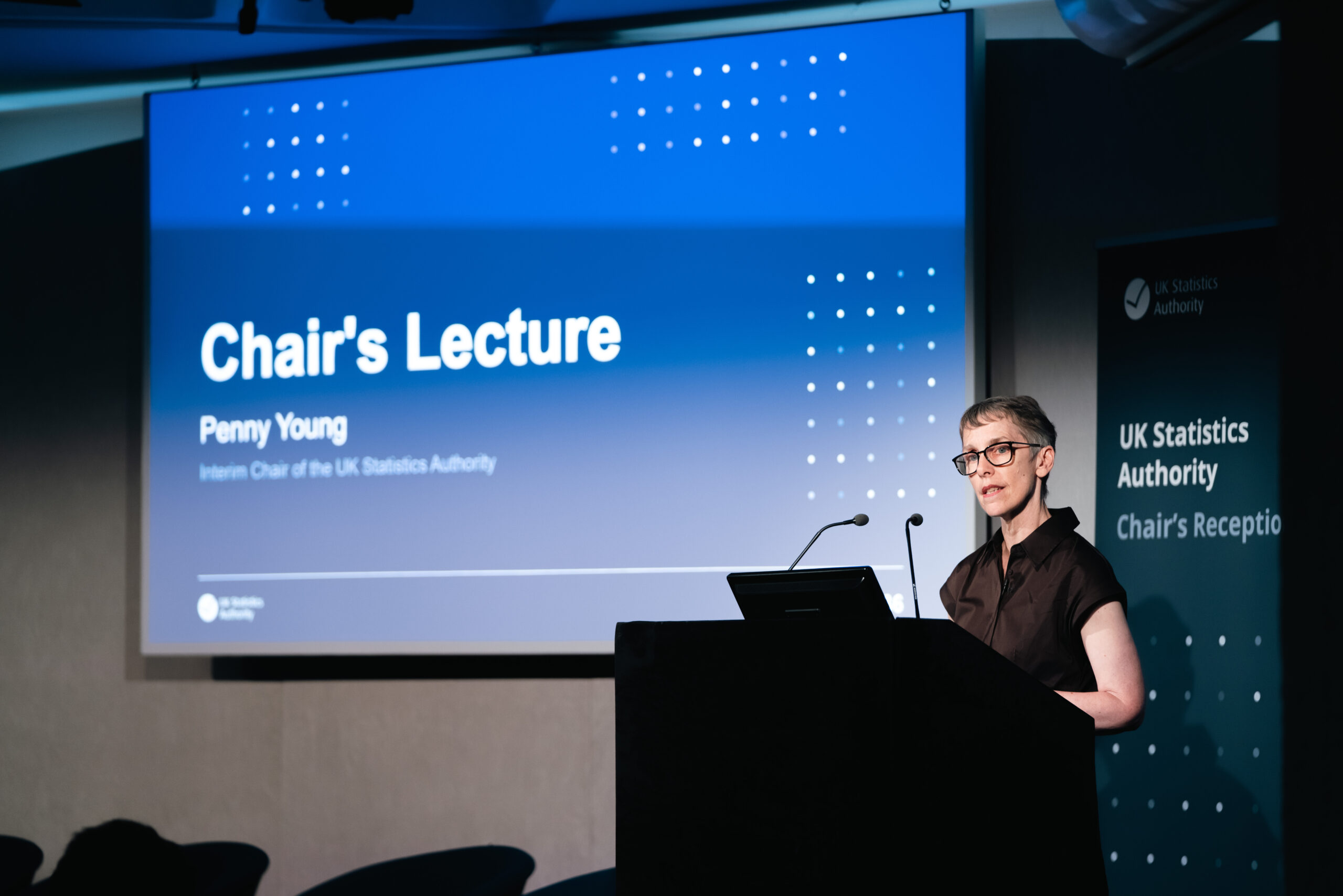
On 2 July 2026, users, producers and stakeholders of official statistics gathered at the Queen Elizabeth II Centre in London for an official Reception with the UK Statistics Authority Chair.
Our keynote address was delivered by Penny Young as interim Chair of the Authority, the first annual speech on the state of the statistical system. This fulfils the last of the outstanding Governance recommendations from Professor Denise Lievesley’s Independent Review of the UK Statistics Authority, and we welcomed Denise to the stage to give her formal response to Penny’s speech afterwards.
They covered a variety of topics across the statistical system, from the work of ONS, to the Assembly, and priorities ahead for the Government Statistical Service. You can read Penny’s full speech and watch the full video of the event below.
The embedded video shows the recording of the Chair’s speech, with a formal response by Prof Lievesley, and then a panel Q&A session.
Introduction
Thank you to Simon for his introduction. (After last year’s public hearings, it’s good to see he has a softer side!) But in all seriousness, I’m an ex House of Commons Librarian. So I believe in parliamentary scrutiny and know his Committee’s report will be instrumental in driving improvement. I’m also a true believer in the need for the UK Statistics Authority to report to parliament to protect the independence of official statistics. So welcome as well to Simon’s fellow PACAC members who are here today – and indeed to all of you.
The impetus for today’s event goes back to Professor Denise Lievesley’s perceptive review of the Authority published in 2024. I’m delighted Denise has agreed to speak today as well. Denise listened to many users, stakeholders and producers, and identified the opportunity to improve the quality of dialogue between us. She observed that while the Authority does not control every part of the system, it can effect more change by stepping into a “more visible and ambitious space”.
She recommended a triennial Statistics Assembly, and an annual public lecture from the Chair of the Authority. The lecture would build on the Office for Statistics Regulation’s annual State of the Statistical System report; and update you on the work of the system and priorities for the year ahead.
So in January 2025, 500 of us gathered for the first Assembly – and it was a tremendous and lively day. Professor David Hand rapidly digested the discussions into clear priorities on sustained user engagement, disaggregation of data, use of administrative data, and coherence across the UK.
We had expected to deliver the Chair’s inaugural lecture last year but events somewhat intervened.
Stakeholders had for some time been publicly expressing concern about ONS and the Labour Force Survey in particular. In 2024, Huw Pill, Chief Economist at the Bank of England, said that the low response rate to the survey meant “a substantial increase in uncertainty for policymakers at a crucial time for the economy”.
The Authority’s regulatory arm, the Office for Statistics Regulation, launched a systemic review of ONS economic statistics in 2024. In spring 2025 it reported common issues around data quality, administrative data and user engagement.
PACAC launched its Inquiry into the Authority in April last year, holding challenging public scrutiny hearings and receiving private concerns from staff about culture.
And Sir Robert Devereux’s review of ONS, jointly commissioned by the Cabinet Office and the Authority Board, concluded in June last year that there were deep-seated issues of performance and culture.
So with leadership in transition, and collective Authority energies focused on the recovery of our National Statistics Institute, it was not the right time to initiate the lecture series. But a year on, we are in a position to honour Denise’s vision for the annual Chair’s lecture. So here we are, reporting to you as users, producers and stakeholders on the statistical system, and indicating the Board’s current priorities.
I’ll be reflecting on:
- ONS’ recovery journey, and a look ahead to the Census
- The system wide priorities identified at the Assembly
- The Government Statistical Service
- Driving appropriate use of statistics in public life
- System leadership and governance
I should mention that OSR published its annual State of the Statistical System last week – copies are available.
Recovery of ONS — Economic statistics in particular
So. ONS. The Labour Force Survey reached a crisis point late in 2023; and furthermore, there were difficulties in developing its strategic replacement, the Transformed Labour Force Survey.
Sir Robert Devereux concluded that problems were deep seated and his prescription was that temporarily at least, the responsibilities of the National Statistician should be split, with a Permanent Secretary appointed to focus specifically on ONS.
Darren Tierney joined in August last year with a mandate to focus on ONS recovery. I’m grateful for the determined progress he has made.
Oversight of recovery has been a key objective for the Board. We’re satisfied that, a year on, ONS is rebuilding.
- The Permanent Secretary has tackled the difficulties by prioritising work strategically and engaged with users before doing so.
- He has reached agreement on the long running dispute about office attendance.
- There has been a real focus on people and culture, and staff engagement scores have improved. There is a detailed People Plan. He has recruited an excellent senior team.
There are many improvements in core statistical products too – too many to list – including:
- Incorporating scanner data into consumer prices and reinstating producer prices
- Ending reliance on the International Passenger Survey for migration data
- Response levels on the Labour Force Survey reaching levels similar to pre-pandemic levels
- The UK’s accreditation by the IMF to their top tier of standards,
But we aren’t there yet. Last month’s operational error on the LFS was a setback.
- It’s important to recognise, as the Board does, that turning an organisation around is not easy: it is neither quick nor entirely linear and problems take time to design out.
- But ONS has reacted transparently; a wide-ranging lessons learned exercise is underway, and processes have already been tightened.
In its State of the Statistics System report, OSR notes positive signs of stabilisation in ONS, greater transparency, stronger governance and more proactive engagement with users. But it also says that important risks remain: sustaining quality, delivering the Transformed Labour Force Survey, implementing the new Statistical Business Register, and improving response rates across social surveys.
And in the Board’s assessment, it’s the foundational capability that takes time to build and deploy, for example: addressing legacy technology, and all the process re-design that goes with that.
In terms of what next, a key priority for the Board is overseeing ONS’ successful transitioning to the Transformed Labour Force Survey. With the Board’s prompting, ONS signalled back in April that we did not expect to be transitioning to TLFS in 2026, with the most likely path in 2027. ONS has delivered all the agreed design changes, and is currently engaging with stakeholders. The Board will take stock on the forward path at its forthcoming July meeting – at the readiness assessment.
I’d draw your attention to the ONS two year Strategy published yesterday providing more detail on recovery and transformation. (Some copies are available today). Longer term, once recovery is embedded, and the permanent Chair and National Statistician are in place there will be a question for the Board as to whether ONS should have a broader scope and ambition. For now, the Board is confident that ONS colleagues have achieved a great deal and are delivering real improvements. But it’s early days.
A word on survey response – something close to my heart having run a survey organisation. It’s not easy.
- Response rates have been declining for a long time, but it’s clear that the pandemic ruptured participation further.
- But surveys still have a vital place in official statistics because of their explanatory power, and control over what’s asked.
- And we risk losing fundamental legitimacy if so few people are willing to participate, and if unweighted results are not reasonably inclusive.
- ONS is exploring the merits and practicalities of mandating response on critical surveys, as recommended by Professor Lievesley, but that could cause its own legitimacy issues.
- And the challenge of nurturing a sustainable fieldforce where face to face interviewing is needed can also be underestimated. It’s a really difficult job – out in all weathers, beyond office hours, and visiting homes where you won’t necessarily get a warm welcome.
Academia, industry and ONS are doing a lot together on this: and it will be a weighty and pressing challenge in the National Statistician’s in-box.
The census and population statistics
Alongside its recovery work, ONS is having to ramp up planning for Census 2031 – it’s the largest operation ONS undertakes. This clearly presents challenges.
There was scepticism at the Assembly — and more widely — about whether we were ready to move away from a questionnaire based census. And in June last year, on the recommendation of the Authority Board, the UK Government commissioned ONS to run a questionnaire-based Census in England and Wales in 2031. It also supported the use of administrative data. Similar decisions have been taken in Scotland and Northern Ireland.
I want to emphasise three points.
First, to thank colleagues across the four nations of the UK — the Chief Statisticians in the Devolved Governments, Alison Byrne at National Records of Scotland, and colleagues in ONS — for the constructive way they are working together both formally and informally. It matters:
- The census helps provide the shared foundations that other parts of the statistical system rely on.
- It can support greater harmonisation and coherence across the UK, while still recognising the different needs, policies and circumstances of each nation. It’s not easy but where we can work together to make UK-wide statistics more coherent, we must. I look forward to hearing Steph Howarth’s reflections on that later from her perspective in the Welsh Government.
Second, the Census must be inclusive by design.
- The Board is taking a keen interest in the harmonised standards.
- Towards the end of 2025 two consultations were launched: the topic consultation for Census 2031, and a Government Statistical Service consultation on whether additional tick-box response options are needed for a new ethnicity harmonised standard.
- The results are currently being analysed.
Inclusivity is also about whether people feel they can see themselves in the questions, whether they trust the Census, and whether they are able and willing to take part. England and Wales achieved a response rate of 97% in 2021, as did Northern Ireland. Scotland faced well-publicised challenges, although excellent subsequent work brought the final response rate to just shy of 90%.
We cannot assume that past levels of participation will repeat themselves. We will need to make a stronger case to the public for the Census: how the data are used, and how they benefit people and communities.
Third, we need strong assurance and governance, not just for the Census but for the wider population statistics system. To support this, the Authority Board has established a dedicated subcommittee.
We’re also conscious that the decision to run a questionnaire-based Census in 2031 does not remove the need to improve population statistics between censuses.
ONS has decided to continue using established methods for official mid-year population estimates, rather than moving immediately to admin-based estimates. These estimates already draw on administrative data, and ONS will keep improving them, with an initial focus on internal migration and the allocation of long-term international migration to local authorities.
But it will need determination. OSR has assessed that ONS population statistics provide broadly credible insights at national level; but highlights real challenges at subnational level, particularly in areas with high migration, student populations and population churn.
The aim is to build a population statistics system grounded in the Census, but strengthened by administrative data. Transparent updates about progress and uncertainty to users will be vital.
Delivering value to the system — Assembly priorities
I want to move on now from ONS to the question of how the statistical system as a whole provides greater value to users and the public, and the four priorities identified at the Assembly.
OSR’s Report is clear that these priorities require co-ordinated effort across the system. It also says that progress has been slower than users might reasonably have expected, and calls for renewed momentum and a clear, time-bound plan. The Board agrees.
The National Statistician’s Office will shortly publish an update on progress, followed by more detailed work over the coming months, and it will be a core responsibility of the incoming National Statistician to drive this agenda once in post.
I accept that we lost momentum in 2025: energy was rightly focused on ONS recovery, and we haven’t been helped by the absence of a permanent National Statistician to drive the system wide priorities. But with ONS recovery well underway, the Board has been clear that these priorities must now move forward.
The test will be whether we can move from strong individual examples to more systematic progress, with a clearer sense of what we are aiming for. Taking each in turn:
User engagement
First, user engagement. Users want to be involved, they want to feel listened to, they want to know what’s happened as a result, and they want value delivered by the system. Absolutely right. And indeed OSR’s updated Code of Practice emphasised the importance of user engagement.
To this end, earlier this year the OSR and the RSS hosted a roundtable examining user engagement in the context of the new Code of Practice. GSS and ONS colleagues have developed six key principles of effective user engagement, which will be consulted on very soon as part of the Assembly update. And they will then form the basis of the GSS user engagement strategy, coming later this year.
Meanwhile, there are good examples of user engagement. OSR gives the example of NHS England discontinuing accredited official statistics on public health only after consulting users and putting arrangements in place for continued access to data through partner organisations.
As we respond to the Assembly challenge, a key question for the Board will be whether all users feel a difference.
Coherence
Second, coherence. Many reviews have highlighted what needs to happen to improve coherence and comparability: including OSR who made some specific recommendations last year.
I have sometimes heard that government statisticians do not receive much demand within their own departments for comparing data across the UK. And it’s disappointing if comparisons are used for nothing more than point scoring. But from a user and public perspective, the inability to compare, say, hospital waiting times across different jurisdictions is frustrating.
But we need to work hard to create the conditions allowing coherence to flourish: shared capability, better data access and sharing, strong relationships across organisations, and collective leadership of the system.
This is not a quick fix. So the Board welcomes the significant progress over the last six months. Work is being done to address these structural issues across the administrations, and a long-term GSS coherence strategy and plan is being developed, set to be published by the end of autumn.
A key element will focus on building an evidence-based understanding of user needs at different geographical levels.
But we are already seeing good work: for example, last week’s publication on the comparability of empty homes data across the nations of the UK.
Granularity
Third, the Assembly called for more granular statistics, and in particular, a portfolio of official and unofficial statistics. Producers (not just ONS) have been under pressure and many users will be feeling losses more than gains here. And the demand for more detail will only grow. In Wales, for example, the new government is taking a keen interest in improved and more granular economic statistics for Wales. And I guess the next Prime Minister might take an interest…
But there is plenty to celebrate too. On place, ONS Local is strengthening relationships with local government through a number of forums including the Mayoral Data Council and working to build capability locally. Another example is the Rural Statistics Working Group, bringing together rural, coastal and island communities with key departments.
We also need to think about the visibility of different sociodemographic groups. I was pleased to join a meeting of the National Statistician’s Inclusive Data Advisory Committee a couple of weeks ago, where external advisers on the Committee were giving advice on how Census 2031 can be ‘inclusive by design’ including addressing barriers around trust, digital exclusion and complex living arrangements. And the National Statistician’s Office is working to improve inclusive data across the GSS – watch out, for example, forthcoming qualitative work on the lived experience of Roma people.
But again, individually good examples only go so far.
Administrative data and data linkage
Everyone here understands the benefits of administrative data and linkage; and why it’s been challenging to liberate the value in such a decentralised system. The closure of the Integrated Data Service was a rational decision but disappointing that collectively we could not make it work. It will however provide some value within ONS.
Even so, a year on, the role of administrative data continues to increase. The Family Resources Survey is now using administrative records to improve information on benefit income. I’ve mentioned the use of admin data in migration estimates and consumer price inflation.
PAYE Real Time Information is also being used in a range of core statistics, supported by more regular and automated supply. It has been shared with ONS and NISRA, and work is under way with National Records of Scotland, which will support more coherent statistics across the four nations.
For Census 2031, administrative data will help us strengthen the census: improving the address frame, helping to target field activity, informing quality assurance, and adding value through linkage to other data sources.
Of course, it is of course vital to maintain the highest standards of security, ethics and trustworthiness as we use and link admin data.
As I’ve said with all four priorities: the challenge is to build from these successful examples into a more routine capability across the system, and to speed up the whole thing.
The development of the Government Statistical Service and statistics profession
Turning now to the producers of statistics, and particularly the Government Statistical Service.
The GSS brings together more than 12,000 people working with statistics across over 50 public bodies, including ONS. Many others are essential too of course, but I will focus here on government statisticians.
The three Deputy Heads of the GSS — Jane Naylor, Steve Ellerd-Elliott and Jason Bradbury — have provided important leadership across this distributed community and across departmental boundaries.
They do this alongside their substantive roles, and have brought real strategic leadership and ambition to the community. I want to thank them for that work, especially during the period without a permanent National Statistician.
Just some of the achievements:
- Driving forward implementation of the GSS’ strategic vision – Strength in Numbers
- Developing a leadership programme (vital for the senior pipeline)
- Making a reality of the GSS in terms of forums, community calls and knowledge sharing
- And promoting implementation of the revised Code
Let me say more about two connected aspects: how the statistician’s role is evolving, and the implications of artificial intelligence for statisticians.
The bold, pithy title of a recent RSS paper was ‘AI is Statistics’ – reminding us that its origins essentially lie in statistical techniques, and training computational models on very large volumes of data. It also reminds us of the pitfalls of AI: producing outputs that are plausible but wrong; reproducing bias from the training data; and sometimes difficult to explain how output has been arrived at.
And so the excellent work GSS has done with the RSS on the evolving nature of the statistician and the skills they will need is really important.
Statisticians have a huge role to play in embracing responsible use of technology innovation because enduring core skills are rooted in evaluating uncertainty in data, working with integrity and guarding against misuse. Combining these values with the huge opportunities to use AI in official statistics is very powerful.
But right now, as OSR identifies, current use of AI in official statistics is limited. (Although ONS’ use of Survey Assist to help code survey responses is a great example).
The Cross-GSS Artificial Intelligence group, chaired by Rachel Skentelbery, is designed to grapple with these issues and harness the enthusiasm. It aims to share experience and good practice system wide. The revised Code of Practice for Statistics will also help , since as OSR notes, where AI is used in the production or communication of statistics, it should be assessed in the same way as other statistical models and methods: with attention to trustworthiness, quality and value.
The aim for GSS leadership, and for the Board, is to build the culture of positive ambition and momentum for the use of AI, while ensuring statisticians’ expertise is also harnessed positively.
Ensuring statistics are used properly
I’ve referenced our regulatory arm, the Office for Statistics Regulation, a great deal. This modestly sized office has substantial impact on the system and under the guidance of the Board’s Regulation Committee has this year sought to further strengthen its approach to regulation.
First, it has strengthened the Code of Practice. Perhaps the biggest change is the addition of a section on ‘Standards for the Public Use of Statistics’. This broadens the scope of OSR’s work, applying in an advisory capacity to all public bodies – not just when they use official statistics. It embeds the concept of ‘intelligent transparency’, and sets out how public bodies should make the evidence behind public claims accessible, and use evidence clearly, accurately, and with integrity. We have deployed it for example in writing to the Covid Inquiry about lockdown modelling, and to Wandsworth Council about council tax claims.
And where we OSR has concerns about how politicians have used official statistics, I will write to them as Chair. To use a cliché – I should note that no one party has a monopoly on attracting our attention. You can find our interventions on the website – recent examples concern doubtful comparisons on universal credit claimants, comparisons on hospital waiting times that are measuring very different things; and moving targets on delivering apprenticeships. Politicians don’t always particularly like our interventions, but we will always act impartially. And ultimately, politicians want to make a difference for the public they serve- that will only happen if statistics are used properly.
More generally, I’m pleased to say that OSR’s SoSS report finds some improvement in the way producers explain uncertainty, limitations and comparability.
Alongside the new Code, OSR’s updated strategy sets out how it will strengthen its own assessment work; focusing hard on being timely, robust in its judgements, and clear in its requirements for improvement.
Governance and leadership
Finally, where are we heading on leadership and governance?
The rapid appointment of a dedicated Permanent Secretary for ONS has restored stability and driven real progress over the past year.
By contrast, it has been frustrating to be without a permanent National Statistician for so long. The process has moved slowly at each stage, but I am pleased to say it is now in its final stages.
In my view, this has not affected ONS recovery, but it has slowed progress on system-wide Assembly priorities, although as I have said, that is now being remedied. And it has prompted better use of system-wide collaboration which we must maintain.
Looking ahead
In due course, the Cabinet Office and the Board will consider the longer-term distribution of responsibilities.
For now, there is no change:
- ONS is benefiting from focused leadership
- And the National Statistician , will have a lot to do: driving system-wide priorities; advising the Board on key statistical decisions; supporting and challenging ONS as its recovery continues and building a strong relationship with the regulator. OSR has identified various things for their to-do list: including baselining the resource situation across the GSS so that we really understand pressures on resourcing.
But as ONS moves further into recovery, we can begin to think about the future model. We’ll need this to be consultative. Whatever the model, the National Statistician must have the bandwidth to provide system-wide leadership. And ONS must continue to benefit from leadership structures that can focus on long term transformation.
Sir Robert Devereux also recommended a longer-term look at governance more broadly. Protecting the independence of the official statistics system is absolutely essential of course. And again, once underway, it must involve the wider statistics community in a meaningful way. In the meantime:
- The number of non-executive directors on the Board will increase in response to our recent Board Effectiveness Review.
- And a revised Framework Agreement between the Cabinet Office and the Authority will be published shortly. This responds to Professor Lievesley’s recommendation and PACAC feedback, while remaining consistent with our statutory independence.
- And in response to Professor Lievesley’s review, the separation between OSR and ONS was publicly clarified.
The competition for a permanent Chair will start once the National Statistician has been announced, and watch out too for the competition for non Executive Directors. I hope I’ve inspired some of you to apply: there is an important job to do. (And it’s not dull…)
Conclusion
Simon Hoare began earlier by reminding us why all of this matters. Parliament, government, business, researchers and the wider public all need trustworthy statistics.
Our job as the Board is to: promote and safeguard the production and publication of official statistics that ‘serve the public good’.
This year we have sought to support and challenge ONS on its recovery journey; work with OSR as it further strengthens its regulatory approach; and re-establish momentum on system wide priorities as we have engaged with leaders across the UK and GSS.
I understand that the ongoing uncertainty about leadership positions causes disquiet, but my assessment is that we are in a better situation all round than a year ago. But today offers a chance to probe that further.
And let me end by thanking colleagues across the system for their work day in, day out. We are collectively fortunate to be working together on something that matters so much.
Thank you.