
Professor Denise Lievesley delivers a formal response to Penny Young’s address
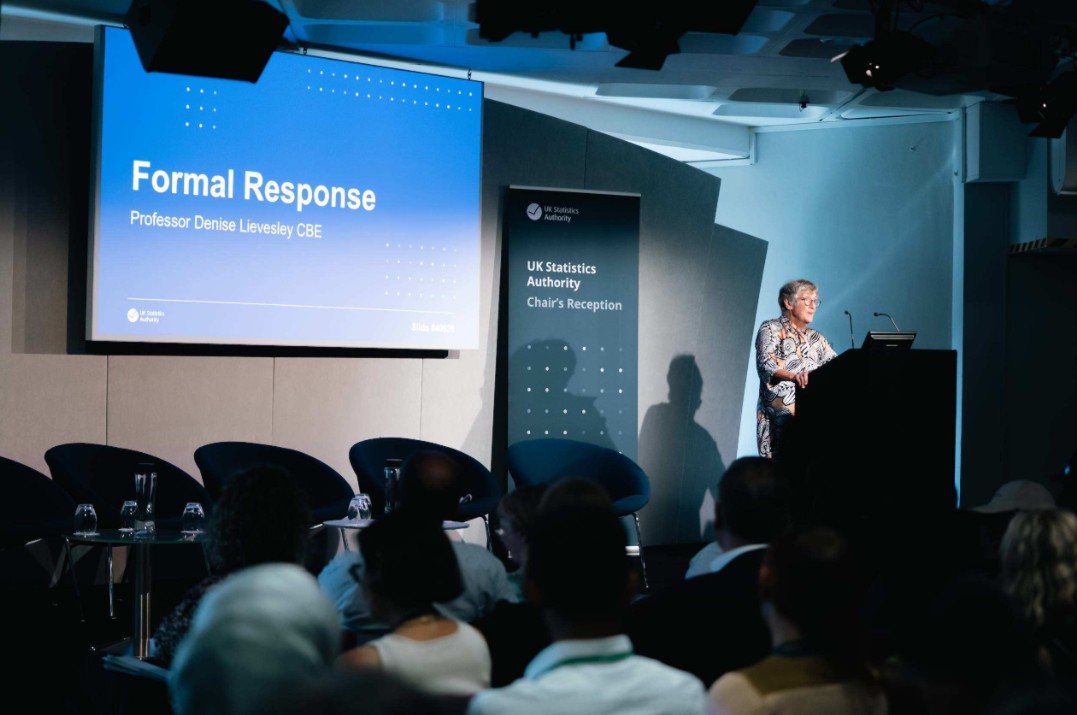
On 2 July 2026, users, producers and stakeholders of official statistics gathered at the Queen Elizabeth II Centre in London for an official Reception with the UK Statistics Authority Chair.
Our keynote address was delivered by Penny Young as Interim Chair of the Authority, the first annual speech on the state of the statistical system. This fulfils the last of the outstanding Governance recommendations from Professor Denise Lievesley’s Independent Review of the UK Statistics Authority, and we welcomed Denise to the stage to give her formal response to Penny’s speech afterwards.
They covered a variety of topics across the statistical system, from the work of ONS, to the Assembly, and priorities ahead for the Government Statistical Service. You can read Professor Lievesley’s formal response and watch the full video of the event below.
The embedded video shows the recording of the Chair’s speech, with a formal response by Prof Lievesley, and then a panel Q&A session.
I extend warm thanks for this invitation to respond to the first annual lecture of the UKSA Chair. May I begin by congratulating Penny on accepting my suggestion to give this talk. As interim chair she could have ducked this. Indeed I think we are all grateful to her for taking on the chairmanship of the Authority with such aplomb and for so long – I know it wasn’t in her life plan!
It seems a long three years since I conducted my review. The perceptions of the UK statistical system at that time retained a halo effect because of the raised profile of statistics during Covid and the success of the Population Census in England and Wales. But as concerns grew about the quality of economic statistics, culminating in an understandable loss of confidence in key labour market statistics, Sir Robert Devereux was asked to focus on the performance of the ONS.
He and I had face-to-face discussions and also attended a meeting of PACAC together. I agreed with his recommendation to create a Permanent Secretary role in ONS (similar to the Chief Operating Officer post I had suggested in my review). Penny is right to record the excellent work conducted by Darren Tierney and colleagues in ONS in addressing data quality. In particular they have created an environment in which statisticians are able to highlight their concerns and admit to problems. This is a change of culture as previously staff were encouraged only to give good news stories. We have also seen this openness in the frank acknowledgement of errors which remain worrying but it is critical to put this in context. There are some 600 outputs from ONS alone in a typical year and it is vital that we appreciate that day in, day out so many important statistics are being published by the GSS.
There is no doubt, as Simon Hoare MP said, that morale in ONS has improved over the last year, but I see growing concern inside and outside the system that the gap without a National Statistician is too long and that we are in need of one. The absence of a statistical leader is impacting our international reputation.
This is what I said two and a half years ago about the role of National Statistician: “it is extremely broad, requiring both strong statistical expertise together with the people skills and business acumen to lead a large organisation. This undermines the resilience of the organisation each time a new leader is sought and the Cabinet Office, working with UKSA, should review the role description well ahead of the next campaign and examine how it is nurturing the talent pipeline within government.”
Such a review was rather overtaken by circumstances, but these circumstances should not be used as an excuse to reduce the importance of having a strong National Statistician in post. In my review, I also recommended the appointment of a Director of Methodology and I stand by this need given the challenges which remain concerning data quality – Penny has outlined many of them in her speech: response rates, the use of administrative data, taking advantage of the power of AI, and the future of the Census, to name just a few.
Response rates may have improved over the last year but they are still only at pre-Covid levels and as such are unacceptably low – to such an extent that we now have to demonstrate representativeness. We must not hide behind the statement that every country is seeing falling response rates – ours are much lower than comparator countries. This is a challenge to us all in the statistical community and those of us working in academia and in business alongside journalists should be helping to tackle this issue. The consortium on adaptive survey designs has a key role here. Partnership with professional societies such as the RSS and scientific academies can expand the expertise available to address the many ‘wicked problems’.
The most agile and innovative statistical agencies across the OECD have strong senior methodologists alongside their Chief Statistician. We can learn from their experiences in developing a cadre of future leaders, and how talent is fostered. Are the boundaries of the UK Statistical system porous enough? And what can other countries teach us about the value of two way secondments, joint projects, etc? Here in the UK, can we build on the experience of ESCoE?
Let me turn now to the Statistics Assembly which is unique internationally and which several NSIs are considering to emulate. I was very pleased that UKSA understood my vision – it is essential that we have a statistical system which meets Government’s needs but, can we discuss these needs alongside those of the broader society ? I was impressed with the energy and enthusiasm put into the Assembly’s organisation, the themes were very thoughtful, and David Hand’s speedy report has helped us to make sure that users are not simply consulted but their views have been actioned. But as Penny indicates making such changes is work in progress. At the Assembly I sensed a real frustration of the participants from local government, but a keenness to get involved. This was most evident in the discussions about the next Census but it was broader than this, as many of them pointed out that they have important and much needed expertise in administrative data. Thus ONS Local is an important initiative which I hope also involves statisticians in the Devolved administrations and broader GSS.
Participation in the Assembly by the private sector was disappointing. We have to find ways in which official statisticians can strengthen their relationships with this sector who are key providers of data but also influencers. A former Commissioner of the Bureau Labor Statistics in the US talked in Paris two weeks ago spoke about how behind-the-scenes influence by high level business men and women stopped an inappropriate appointment being made to the top of the BLS. I hope that the Assembly has spurred thinking about how we can get a much better and prolonged relationship across users, producers, experts and critical friends. The National Statistician’s Advisory Boards play a vital role as I assume Kate Barker will tell us, but they still feel rather cosy. We must be open to a wider community – we need more advocates for a statistical system of integrity and we need to be open to challenge too.
I mentioned a meeting in Paris earlier. This was a conference organised because of concerns as to whether the French Statistical System is strong enough to withstand major political change which could lead to a government possibly not committed to quality statistics as we might define them. A small number of us from the UK were invited, alongside a similar group from the USA. Ed Humpherson was one of the UK delegation, invited because the OSR is seen, quite rightly, as a critical element in the protection of the independence in the UK. It is the envy of many countries. But is our system robust enough to withstand pressure in a malign environment? And as a former UN statistician, I can yell you I’ve worked in a number of countries with malign environments. I know that many in this audience have concerns as to whether there is sufficient independence of OSR from ONS. I welcome Penny’s reassurance that clarity has been provided over the independence and reporting system of the head of the OSR.
The head of the OSR provides professional leadership, sometimes confidentially, particularly to the statisticians in sectoral departments. OSR has been diligent in promoting a revised Code of Conduct and I am aware that the tenets of trustworthiness, quality and value are increasingly recognised in the UK and beyond. I do want to raise the fact that interference in the statistical system can occur in ways it is hard to protect unless we have leaders with a clear view of professional autonomy. As I highlighted in my Review, and as I have experience of from my youth when I was an official statistician, one of the ways to avoid uncomfortable truths is not to collect the data in the first place.
One of the questions often raised at international gatherings is whether the UK is more vulnerable to interference and misuse of statistics because of its decentralised system. Incidentally I am very pleased to hear about the triumvirate leading the GSS and am sure this will be a great support to an incoming National Statistician. Decentralisation permits the development of subject-matter expertise enabling statisticians to develop a deep understanding of data quality, including being able to understand the limitations of a given data set relative to the problem at hand. But it does mean it is harder to create a coherent and integrated statistics system. Many of the issues we need to address are cross-cutting or multi-dimensional and we aren’t good at bringing statistics together to address these issues. I would like to see more rapid progress being made on how to provide access to integrated data. The suspension of the IDS was necessary given the constrained resources but the need for better data sharing remains and we must address improved incentives (or the removal of disincentives) for data sharing.
One of the aspects of the UK statistics system which concerned me was the lack of resources and support being given to statisticians working in the devolved administrations. I was extremely pleased, therefore, to hear Penny report on ways in which the UKSA has been trying to improve the position of statisticians in Scotland, Wales, and Northern Ireland, and has been seeking to overcome the fragmentation of the UK in the statistical landscape whilst respecting the need for different data reflecting different administrative systems, priorities and societal interests – what I would call a system of mutual respect.
Statisticians in these nations tell me there’s a need to keep the pressure on, particularly on recommendations which are yet to be actioned. I understand they feel we must continue to promote cross-system working. Again, accepting that absent leadership constrains progress, I think there is more to be done to make data sharing and cross-government working an everyday reality rather than the notable exception.
One of my regrets in conducting the Review is that funding was determined to be beyond my remit. Funding is critical, and maybe this will be addressed in the PACAC report. The system for determining the budget for statistics across the whole of the GSS is opaque and it is hard for us to debate priorities in the absence of information on the costs of activities. Similarly, I don’t think serious headway has been made on the funding position for the statistics system in the three smaller nations, and I am aware that many of the teams in the GSS are really quite tiny and under resourced considering the vital nature of their output. A discussion of resources is increasingly important for the ONS too given they have dropped key work, particularly on social and health aspects of our society. They’ve done this in order to prioritise the economic data. I would argue that some of the problems with the response rates on the Labour Force Survey are due to expecting that survey to fulfil too many aims, this being cheaper than launching additional surveys. And when we look to the future it is critical that we realise that the way to reduce the capacity, the influence, of a statistical agency, is to starve it of funds as we have seen in the USA.
As the Reuters Institute for the Study of Journalism tells us that 2026 marks a global milestone where social media and video platforms have overtaken traditional outlets as the primary source of news, it is vital that the skills of our statisticians and official statistical agencies keeps pace with those societal changes.
Finally, I want to underscore a greater sense of urgency and jeopardy, particularly around the recruitment of a National Statistician. I do worry that, notwithstanding the huge commitment of Penny in stepping into the role of Chair, and of Darren and colleagues in tackling data quality, we are treading water in many aspects of the professional development of the statistical system as we await the appointment of a National Statistician; as we await the appointment of a permanent head of the UKSA, new non-exec members and the report from PACAC. The volume and scale of misinformation and of exploited misunderstanding, is probably unparalleled. We need a confident, brave, outward looking and engaged statistical system more than ever before. I welcome Penny’s positive assessment of the progress that’s been made.
Thank you.